Generative AI vs Machine Learning: Understanding Their Role in the AI Revolution

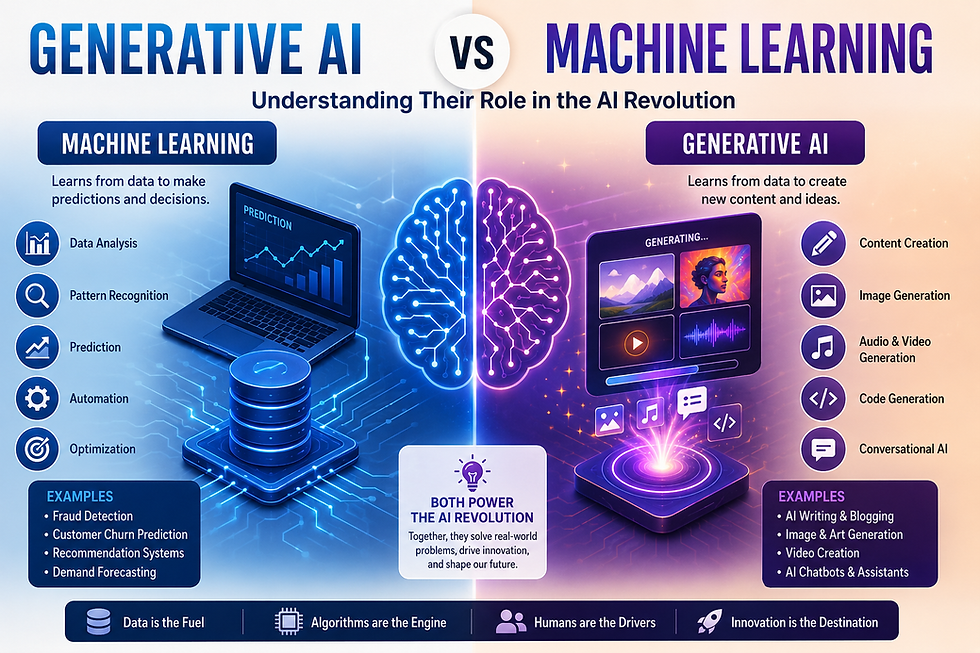
The debate around Generative AI vs Machine Learning has become one of the most discussed topics in modern technology. Artificial Intelligence (AI) is transforming industries, reshaping business operations, and changing the way humans interact with machines. Among the many branches of AI, Machine Learning (ML) and Generative AI stand out as two highly influential technologies.
While both belong to the broader AI ecosystem, they serve different purposes. Machine Learning focuses on analyzing data, recognizing patterns, and making predictions. Generative AI, on the other hand, goes a step further by creating entirely new content such as text, images, videos, music, and even software code.
Understanding Generative AI vs Machine Learning helps businesses, students, and professionals make informed decisions about adopting AI technologies. As organizations continue investing heavily in AI-powered solutions, knowing the differences between these technologies is essential for staying competitive.
This blog explores the foundations, applications, and differences between Generative AI and Machine Learning to help you understand their roles in the ongoing AI revolution.
What Is Artificial Intelligence?
Artificial Intelligence refers to the simulation of human intelligence by machines. AI systems are designed to perform tasks that typically require human cognitive abilities, such as reasoning, learning, decision-making, problem-solving, and language understanding.
AI has evolved significantly over the last decade due to advancements in computing power, cloud infrastructure, and data availability. Today, AI powers many everyday technologies, including:
Voice assistants like Siri and Alexa
Recommendation engines on streaming platforms
Self-driving vehicle technologies
Fraud detection systems in banking
Chatbots for customer service
AI can be categorized into three main types:
Narrow AI
Designed for specific tasks such as facial recognition or spam filtering.
General AI
A theoretical AI capable of human-level intelligence across multiple domains.
Super AI
An advanced future concept where AI surpasses human intelligence.
In the discussion of Generative AI vs Machine Learning, both technologies fall under Narrow AI because they specialize in solving particular types of problems.
AI matters today because it improves productivity, reduces manual effort, and helps businesses make faster decisions. From healthcare to education, AI is becoming a foundational technology for digital transformation.
What Is Machine Learning?
Machine Learning is a subset of Artificial Intelligence that enables computers to learn from data without being explicitly programmed for every task.
Instead of following fixed rules, Machine Learning algorithms analyze data patterns and improve performance over time. The more quality data the model receives, the better it becomes at predictions and classifications.
For example, if you train a Machine Learning model with thousands of emails labeled as spam or non-spam, it learns patterns that help it identify spam in the future.
Machine Learning is widely used because it automates complex decision-making processes. Common Machine Learning applications include:
Email spam detection
Product recommendations
Credit scoring
Customer behavior analysis
Disease prediction
The core goal of Machine Learning is prediction. It answers questions such as:
Will this customer buy a product?
Is this transaction fraudulent?
Will this machine fail soon?
When comparing Generative AI vs Machine Learning, Machine Learning primarily focuses on identifying and predicting patterns from existing data rather than creating new outputs.
Machine Learning has become essential for businesses because it helps improve accuracy, reduce operational costs, and uncover hidden insights in massive datasets.
How Machine Learning Works
Machine Learning works through a structured process involving data collection, training, testing, and prediction.
Step 1: Data Collection
Data is gathered from various sources such as databases, websites, sensors, or applications.
Examples include:
Customer purchase history
Medical records
Website traffic data
Social media interactions
The quality of data directly affects model performance.
Step 2: Data Preparation
Raw data is cleaned and organized by removing errors, duplicates, or irrelevant information.
This stage may involve:
Filling missing values
Standardizing formats
Removing noise
Clean data leads to better predictions.
Step 3: Model Training
The prepared data is fed into a Machine Learning algorithm.
The model identifies patterns and relationships between variables.
Example:A housing price model may learn that:
Larger houses cost more
Better locations increase value
Newer homes sell at higher prices
Step 4: Testing
The trained model is tested using unseen data to evaluate performance.
Common evaluation metrics include:
Accuracy
Precision
Recall
F1 Score
Step 5: Prediction
Once trained, the model makes predictions using new data.
Example:Predicting whether a customer is likely to cancel a subscription.
This workflow explains why Machine Learning excels in analytical and predictive tasks. In the Generative AI vs Machine Learning comparison, this predictive nature is a major distinction.
Types of Machine Learning
Machine Learning can be divided into several major categories.
Supervised Learning
In supervised learning, models train on labeled data.
Example:A dataset contains images labeled as cats or dogs.
The model learns from known inputs and outputs.
Applications include:
Fraud detection
Medical diagnosis
Price prediction
Unsupervised Learning
This method uses unlabeled data.
The algorithm discovers hidden patterns independently.
Applications include:
Customer segmentation
Market basket analysis
Pattern recognition
Semi-Supervised Learning
This combines small labeled datasets with large unlabeled datasets.
Useful when labeling data is expensive.
Applications include:
Speech recognition
Image classification
Reinforcement Learning
A model learns by trial and error using rewards and penalties.
Applications include:
Robotics
Game AI
Autonomous vehicles
Understanding these ML types is important when analyzing Generative AI vs Machine Learning, because many generative systems rely on ML foundations.
What Is Generative AI?
Generative AI is a branch of Artificial Intelligence focused on creating new content rather than simply analyzing existing data.
Unlike traditional Machine Learning models that predict outcomes, Generative AI produces original outputs that resemble human-created content.
Examples of generated content include:
Blog articles
AI-generated art
Music compositions
Product designs
Video generation
Source code
Generative AI learns patterns from massive datasets and uses those patterns to generate realistic outputs.
For instance, a text-generation model trained on books, articles, and websites can write essays, answer questions, and create marketing copy.
Popular Generative AI tools include:
OpenAI’s ChatGPT
Google Gemini
Adobe Firefly
Midjourney image generator
Generative AI has exploded in popularity because it can automate creative workflows. This capability creates a major distinction in Generative AI vs Machine Learning discussions.
Instead of merely predicting outcomes, Generative AI creates something new.
How Generative AI Creates Content
Generative AI creates content by learning patterns from large-scale datasets and then using those learned relationships to generate original outputs.
The process typically involves:
Training on Massive Data
Generative AI models train on enormous datasets containing:
Text
Images
Audio
Video
Code
The system learns relationships between words, pixels, sounds, and structures.
Pattern Learning
The model identifies recurring patterns.
For example:
Sentence structures in language
Visual patterns in images
Rhythms in music
Content Generation
When prompted by a user, the AI predicts what output should come next based on learned patterns.
Example prompt:“Write a blog about AI.”
The model generates relevant sentences word by word.
Generative AI doesn’t copy content directly. Instead, it synthesizes new outputs based on statistical relationships.
This is a major difference in Generative AI vs Machine Learning. Traditional ML predicts categories or numerical values, whereas Generative AI produces original content.
This capability makes Generative AI highly valuable for content creation, marketing, design, and software development.
Core Technologies Behind Generative AI
Several advanced technologies power modern Generative AI systems.
Neural Networks
Neural networks are computing systems inspired by the human brain.
They consist of interconnected layers that process information.
These networks help AI recognize complex patterns.
Deep Learning
Deep Learning uses multi-layer neural networks to analyze huge datasets.
It is essential for:
Image generation
Speech synthesis
Language modeling
Transformers
Transformers revolutionized AI by enabling better handling of sequential data like language.
They allow models to understand context and relationships between words.
Most modern language models rely on transformer architecture.
Large Language Models (LLMs)
LLMs are massive AI models trained on huge text datasets.
Examples include:
GPT models
Gemini models
Claude models
These models power advanced chatbots and writing assistants.
These technologies explain why Generative AI feels human-like in conversations, making the Generative AI vs Machine Learning comparison even more interesting.
Generative AI vs Machine Learning
Understanding the key differences between Generative AI vs Machine Learning is essential.
Purpose
Machine Learning: Predicts outcomes using existing data.Generative AI: Creates new content.
Output
Machine Learning: Labels, scores, recommendations.Generative AI: Text, images, audio, video, code.
Data Usage
Machine Learning: Learns patterns for prediction.Generative AI: Learns patterns for content creation.
Complexity
Machine Learning: Usually simpler and task-specific.Generative AI: Requires massive models and computing power.
Business Use Cases
Machine Learning:
Fraud detection
Forecasting
Analytics
Generative AI:
Content creation
Design automation
Virtual assistants
This comparison makes one thing clear: Generative AI builds upon Machine Learning but serves broader creative purposes.
Data Processing in Generative AI vs Machine Learning
Data processing differs significantly in Generative AI vs Machine Learning.
Machine Learning Data Processing
Machine Learning typically works with structured or semi-structured data such as:
Tables
Customer records
Financial data
Sensor readings
The goal is extracting meaningful patterns for prediction.
Example:A bank uses ML to predict loan defaults.
Generative AI Data Processing
Generative AI often processes unstructured data such as:
Text documents
Videos
Audio files
Images
Code repositories
The goal is understanding patterns deeply enough to generate new outputs.
Generative AI requires significantly more data and computational power than traditional ML.
For example:Training a modern AI language model may require billions of data points.
This makes infrastructure a major factor when choosing between these technologies.
In the debate around Generative AI vs Machine Learning, data processing reveals a critical difference: ML focuses on analysis, while Generative AI focuses on creation.
Training Methods Used in Both AI Technologies
Training is the foundation of both Machine Learning and Generative AI. Without proper training, AI systems cannot learn patterns or deliver useful outputs.
Machine Learning Training
Machine Learning models are trained using datasets containing examples and labels. The model continuously adjusts internal parameters to reduce prediction errors.
Common training methods include:
Supervised learning
Unsupervised learning
Reinforcement learning
Example:A fraud detection system learns from past transaction records labeled as fraudulent or safe.
The model improves as it processes more examples.
Generative AI Training
Generative AI training is more complex. These models are trained on enormous datasets that may include billions of text documents, images, videos, or code samples.
Training involves:
Pattern recognition
Context understanding
Probability-based generation
Large generative models often require:
High-end GPUs
Massive storage
Distributed computing infrastructure
In Generative AI vs Machine Learning, training complexity is one of the biggest differences. Traditional ML can often run on modest infrastructure, while Generative AI usually demands enterprise-scale computing resources.
Popular Use Cases of Machine Learning
Machine Learning has become deeply integrated into modern business operations. It helps organizations automate analysis and improve decision-making.
Popular Machine Learning applications include:
Fraud Detection
Banks use ML to identify suspicious transactions in real time.
Recommendation Engines
Streaming platforms and e-commerce websites recommend content based on user behavior.
Examples include:
Netflix recommendations
Amazon product suggestions
Predictive Maintenance
Manufacturing companies predict machine failures before breakdowns occur.
Healthcare Diagnostics
ML helps doctors detect diseases from medical scans and patient data.
Customer Churn Prediction
Businesses identify which customers may stop using their services.
These applications show why Machine Learning remains essential in the Generative AI vs Machine Learning debate. ML continues to dominate predictive analytics.
Top Applications of Generative AI in 2026
Generative AI adoption has grown rapidly across industries. Businesses now use it to automate creative and repetitive tasks.
Major applications in 2026 include:
Content Creation
AI writes:
Blogs
Emails
Marketing copy
Social posts
Image Generation
Designers create visuals using AI tools.
Examples include:
Logos
Advertisements
Product mockups
Code Generation
Developers use AI coding assistants to speed up software development.
Examples:
GitHub Copilot
AI coding assistants
Video Production
AI helps generate animations, subtitles, and synthetic videos.
Virtual Assistants
AI chatbots now provide human-like conversations for customer support.
Education
AI creates:
Personalized lessons
Practice tests
Study summaries
This demonstrates how Generative AI vs Machine Learning is shifting. Generative AI is expanding beyond analytics into creative and productivity-driven workflows.
Benefits of Machine Learning for Businesses
Machine Learning provides significant business value by turning raw data into actionable insights.
Better Decision-Making
ML identifies trends humans may overlook.
Example:Retail companies forecast seasonal demand more accurately.
Increased Efficiency
Automation reduces manual work in data-heavy operations.
Cost Reduction
Predictive models help avoid expensive mistakes.
Examples:
Prevent equipment failures
Reduce fraud losses
Personalization
Businesses deliver customized experiences based on user behavior.
Examples include:
Personalized ads
Product recommendations
Dynamic pricing
Scalability
Machine Learning models can process millions of records quickly.
In Generative AI vs Machine Learning, ML remains a core technology for businesses focused on analytics, optimization, and forecasting.
Advantages of Generative AI
Generative AI brings unique benefits that traditional Machine Learning cannot easily provide.
Faster Content Production
Businesses create large amounts of content in less time.
Examples:
Blog posts
Product descriptions
Ad copy
Enhanced Creativity
Generative AI helps brainstorm new ideas and concepts.
Design teams use AI to accelerate innovation.
Automation of Creative Work
Tasks once requiring hours can now take minutes.
Examples:
Image editing
Script writing
Presentation creation
Better Customer Engagement
AI assistants provide instant, personalized interactions.
Increased Productivity
Employees can focus on strategy while AI handles repetitive creative tasks.
In Generative AI vs Machine Learning, this creative capability gives Generative AI a distinct advantage in content-driven
industries.
Challenges of Machine Learning
Despite its benefits, Machine Learning has limitations.
Data Dependency
Poor-quality data leads to poor predictions.
This is often summarized as:“Garbage in, garbage out.”
Bias in Data
Biased training data produces biased outcomes.
Example:Hiring models may unfairly favor certain applicant profiles.
Limited Flexibility
Traditional ML models usually perform specific tasks only.
A fraud detection model cannot automatically perform language generation.
Maintenance Requirements
Models need regular retraining as data changes over time.
This issue is known as model drift.
In the Generative AI vs Machine Learning comparison, ML may be easier to deploy, but maintaining long-term accuracy remains challenging.
Risks and Ethical Concerns in Generative AI
Generative AI introduces serious ethical challenges.
Misinformation
AI can generate convincing but false content.
Examples include:
Fake news
Fabricated reports
Manipulated media
Deepfakes
AI-generated videos and audio can imitate real people.
This raises concerns around fraud and identity misuse.
Copyright Issues
AI models trained on public data may create legal disputes over ownership.
Creators increasingly question how training data is used.
Bias and Harmful Outputs
Generative models may reproduce harmful stereotypes present in training data.
Security Risks
Cybercriminals may misuse Generative AI for:
Phishing attacks
Social engineering
Malware generation
These concerns make governance crucial in the future of Generative AI vs Machine Learning.
How Generative AI and Machine Learning Work Together
Generative AI and Machine Learning are not competitors—they often complement each other.
Machine Learning provides predictive intelligence, while Generative AI adds creative capability.
Examples of collaboration include:
Customer Service
ML predicts customer intent.Generative AI creates natural responses.
Healthcare
ML detects disease risk.Generative AI generates patient-friendly explanations.
Marketing
ML analyzes customer preferences.Generative AI creates personalized campaigns.
This synergy shows that Generative AI vs Machine Learning should not always be viewed as a competition. In many cases, the strongest AI solutions combine both technologies.
Future Trends in the AI Revolution
The AI revolution is still accelerating.
Key future trends include:
Smaller AI Models
Businesses are increasingly adopting lightweight models for faster deployment.
Multimodal AI
AI systems now understand:
Text
Audio
Images
Video
Together.
Industry-Specific AI
Customized AI solutions are growing in:
Healthcare
Finance
Education
Manufacturing
Human-AI Collaboration
AI will increasingly act as a co-pilot rather than a replacement for human workers.
Stronger AI Regulation
Governments and organizations are building frameworks for responsible AI use.
The future of Generative AI vs Machine Learning will likely involve deeper integration rather than replacement.
Conclusion:
The discussion around Generative AI vs Machine Learning highlights two powerful technologies driving the AI revolution.
Machine Learning focuses on:
Prediction
Classification
Pattern recognition
Generative AI focuses on:
Content creation
Creativity
Human-like interaction
Both technologies are essential, but they serve different purposes.
If your goal is analytics and forecasting, Machine Learning is highly effective. If your goal is automation of creative workflows and content generation, Generative AI offers exceptional value.
The future of AI will not be about choosing one over the other. Instead, success will come from understanding how both technologies can work together to transform industries, enhance productivity, and unlock innovation.


Comments