.png)


Static vs Non-Static Members in Java: Key Concepts and Differences

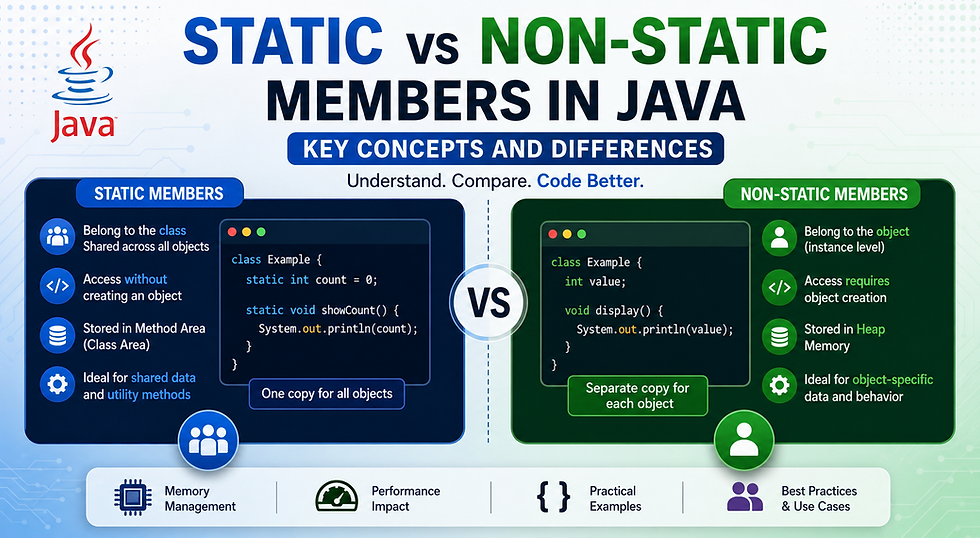
In Java, understanding the difference between static and non-static members is essential for writing efficient and scalable programs. Static members belong to the class, while non-static members belong to objects. This fundamental concept affects memory usage, access methods, and program design. Beginners often confuse when to use static or instance members, leading to inefficient code. In this guide, we’ll break down the key concepts, practical use cases, and differences between static and non-
static members in Java, helping you build a strong foundation for object-oriented programming.
What Are Static Members in Java?
Static members in Java are variables or methods declared using the static keyword. They belong to the class rather than any specific object. This means you can access them without creating an instance of the class. Static members are shared across all objects, making them memory-efficient when common data is required. For example, a static variable can store a shared value like a company name. Static methods are commonly used for utility functions. Since they are class-level, they cannot directly access non-static members.
What Are Non-Static Members in Java?
Non-static members, also known as instance members, belong to individual objects of a class. Each object has its own copy of non-static variables, allowing unique data storage. These members require object creation to be accessed. Non-static methods can access both static and non-static members, making them more flexible. They are widely used when behavior or data differs between objects. For example, in a Student class, each student will have a unique name and ID stored in non-static variables.
Key Differences Between Static and Non-Static Members
The primary difference between static and non-static members lies in ownership and access. Static members belong to the class and are shared across instances, while non-static members belong to individual objects. Static members can be accessed without object creation, whereas non-static members require an instance. Memory allocation also differs, as static members are stored in the class area, while non-static members reside in heap memory. Additionally, static methods cannot directly access instance variables, but non-static methods can access both types.
Understanding Static Variables with Examples
Static variables are declared using the static keyword and are shared across all instances of a class. They are initialized only once and stored in a common memory location. This makes them ideal for constants or shared counters. For example, a static variable can track the total number of objects created. Whenever a new object is instantiated, the same static variable is updated. This shared behavior helps reduce memory usage and ensures consistency across all objects in a Java program.
Understanding Non-Static Variables with Examples
Non-static variables are instance-specific and are created every time a new object is instantiated. Each object maintains its own copy, allowing unique values. For example, if you create multiple objects of a Car class, each car can have different attributes like color, speed, or model. This makes non-static variables essential for representing real-world entities. They are stored in heap memory and are accessed using object references. Unlike static variables, changes in one object do not affect others.
Static Methods in Java Explained
Static methods belong to the class and can be called without creating an object. They are commonly used for utility or helper functions, such as mathematical calculations. Static methods can only directly access static variables and other static methods. They cannot use this or super keywords because they are not tied to any instance. For example, the main method in Java is static, allowing the program to run without creating an object first. This makes static methods efficient for operations that do not depend on object state.
Non-Static Methods in Java Explained
Non-static methods are associated with objects and require an instance to be invoked. They can access both static and non-static members, making them more versatile. These methods are used when behavior depends on the object’s state. For example, a method that calculates a student’s grade based on marks must be non-static because it relies on instance data. Non-static methods use the this keyword to refer to the current object, enabling object-specific operations and interactions within the program.
Memory Allocation: Static vs Non-Static Members
Memory allocation differs significantly between static and non-static members in Java. Static members are stored in the method area (or class area), which is shared across all objects. They are loaded once when the class is loaded. In contrast, non-static members are stored in heap memory, and each object gets its own copy. This distinction impacts performance and memory usage. Static members are more memory-efficient for shared data, while non-static members provide flexibility for object-specific data handling.
When to Use Static Members in Java
Static members should be used when data or behavior is common to all objects. They are ideal for constants, configuration values, and utility methods. For example, a static method can perform calculations that do not depend on object data. Static variables are useful for counters or shared resources. However, overusing static members can reduce flexibility and violate object-oriented principles. It is best to use static members only when necessary, ensuring clean and maintainable code design.
When to Use Non-Static Members in Java
Non-static members should be used when data or behavior varies between objects. They are essential for representing real-world entities where each instance has unique properties. For example, in a banking application, each account will have different balances and account numbers. Non-static methods allow operations based on object-specific data. They are also crucial for implementing object-oriented principles like encapsulation and inheritance. Whenever your logic depends on instance-level data, non-static members are the correct choice for flexibility and scalability.
Advantages of Static Members
Static members offer several benefits in Java programming. They reduce memory consumption since only one copy is shared across all instances. Static methods are easy to access without object creation, making them ideal for utility or helper functions. They also improve performance when handling shared data. Additionally, static members simplify code structure when dealing with constants or configuration settings. Their class-level accessibility ensures consistent data across all objects, which is useful in scenarios like logging, caching, or maintaining global counters.
Advantages of Non-Static Members
Non-static members provide flexibility by allowing each object to maintain its own state. This makes them ideal for modeling real-world scenarios. They support object-oriented programming concepts such as encapsulation, inheritance, and polymorphism. Non-static methods can access both instance and static members, increasing their usability. They also enable dynamic behavior, where each object can perform operations based on its own data. This level of customization is essential for building scalable and maintainable Java applications.
Limitations of Static Members
Despite their benefits, static members have certain limitations. Since they are shared across all objects, changes made in one place affect all instances, which can lead to unexpected behavior. Static methods cannot directly access non-static members, limiting their flexibility. Overuse of static members can make code less modular and harder to test. They also break object-oriented principles if used excessively. Therefore, developers should use static members carefully and only when shared behavior is required.
Limitations of Non-Static Members
Non-static members require object creation, which can increase memory usage when many instances are created. Each object holds its own copy of instance variables, making them less efficient for shared data. Additionally, accessing non-static members involves object references, which may slightly impact performance. Improper use of instance members can also lead to complex and hard-to-maintain code. Developers must strike a balance between static and non-static usage to ensure optimal performance and clean design.
Static Block in Java: Concept and Use Cases
A static block in Java is used to initialize static variables. It runs only once when the class is loaded into memory. Static blocks are useful for performing complex initialization tasks that cannot be handled in a single line. For example, loading configuration settings or initializing database connections can be done using a static block. Since it executes before the main method, it ensures that static data is ready for use. Static blocks improve code organization when handling class-level initialization logic.
Real-World Examples of Static vs Non-Static Usage
In real-world applications, static and non-static members are used together. For instance, in an e-commerce application, a static variable can store the company name, while non-static variables store product details like price and quantity. Similarly, utility classes use static methods for operations like calculations or formatting. On the other hand, user-specific data such as profiles or orders rely on non-static members. This combination ensures efficient memory usage while maintaining flexibility for object-specific behavior.
Common Mistakes to Avoid
Many beginners make mistakes when using static and non-static members in Java. One common error is trying to access non-static variables inside static methods without creating an object. Another mistake is overusing static variables, which reduces code flexibility. Developers also forget that static members are shared across all instances, leading to unintended data changes. Ignoring proper object-oriented design principles can result in poorly structured code. Avoiding these mistakes helps in writing clean, efficient, and maintainable Java programs.
Best Practices for Using Static and Non-Static Members
To use static and non-static members effectively, follow best practices. Use static members only for shared data or utility methods. Avoid excessive use of static variables to maintain object-oriented design. Prefer non-static members when dealing with instance-specific data. Keep your code modular and well-structured. Use clear naming conventions to distinguish between static and instance members. Additionally, ensure proper documentation and testing to avoid unexpected behavior. Following these practices improves code readability and maintainability.
Static vs Non-Static: Performance Comparison
When comparing performance, static members are generally more memory-efficient because they are shared across all objects. They also reduce the overhead of object creation for certain operations. However, non-static members provide better flexibility and scalability. The performance difference is usually minimal in modern applications, but choosing the right approach depends on the use case. Static members are ideal for shared data, while non-static members are better for object-specific operations. A balanced approach ensures optimal performance and design.
Conclusion:
Choosing between static and non-static members in Java depends on your application requirements. Static members are suitable for shared data and utility functions, while non-static members are essential for object-specific behavior. Understanding their differences helps in writing efficient, scalable, and maintainable code. By following best practices and avoiding common mistakes, developers can leverage both types effectively. A balanced approach ensures optimal performance and adherence to object-oriented principles, making your Java programs robust and future-ready.
Frequently Asked Questions (FAQs)
Q1: Can static methods access non-static variables?
No, static methods cannot directly access non-static variables because they belong to the class, not instances.
Q2: Do static variables get memory for each object?
No, static variables are shared and stored only once in memory.
Q3: Why is the main method static in Java?
The main method is static so that the JVM can call it without creating an object of the class.
Q4: Can we override static methods?
No, static methods cannot be overridden but can be hidden.
Q5: Which is better: static or non-static?
It depends on the use case. Static is best for shared data, while non-static is ideal for instance-specific data.
Read More Blogs:
Read More: What is StringBuilder in Java?
Read More: Java String vs StringBuilder
Read More: How to Become an Ethical Hacker
Read More : Types of Data
Read More: Types of Data Analytics
Read More: Data Analyst Skills
Read More: Ethical Hacking Course Syllabus


Comments