


DBA vs. MBA: Differences in Career Opportunities and Salary

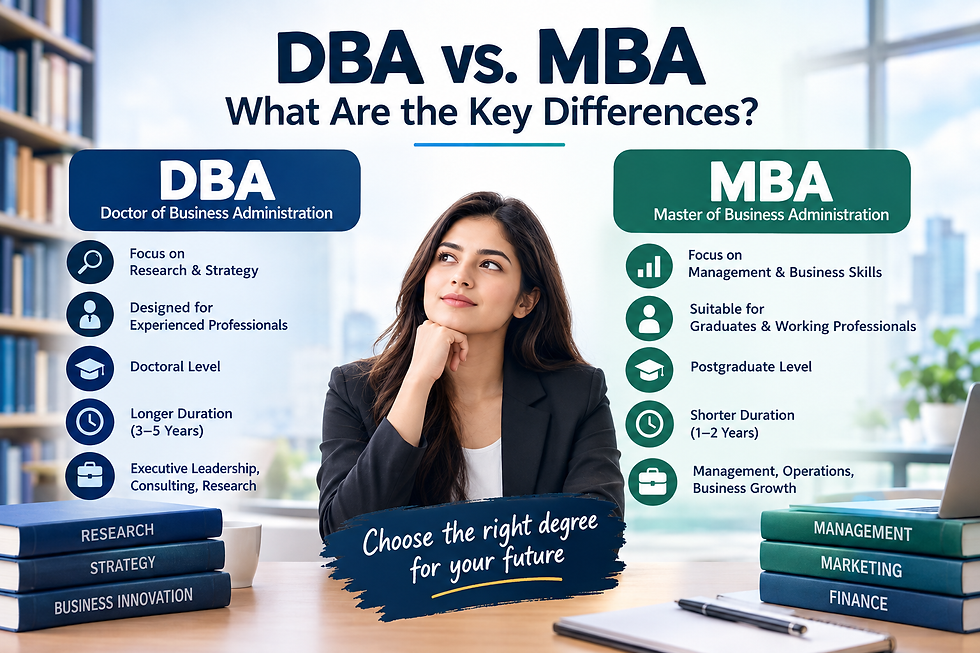
Choosing between a Doctor of Business Administration (DBA) and a Master of Business Administration (MBA) is an important decision for professionals who want to advance their careers. Both degrees develop business knowledge, leadership abilities, and strategic thinking, but they differ in academic depth, career opportunities, and earning potential.
Understanding the DBA vs. MBA comparison can help you select a degree that matches your experience, professional goals, and long-term ambitions. While an MBA generally prepares graduates for management and leadership positions, a DBA focuses on advanced business practice, applied research, and executive-level decision-making.
This blog explores the key differences between DBA and MBA programs, including career paths, salary expectations, industry opportunities, and the factors to consider before enrolling.
What Is an MBA?
A Master of Business Administration (MBA) is a postgraduate degree designed to develop management, leadership, and business strategy skills. It is suitable for recent graduates, working professionals, and individuals seeking career advancement.
MBA programs typically cover finance, marketing, operations, human resources, business analytics, and organizational leadership. Students may also participate in internships, case studies, group projects, and business simulations.
An MBA can help professionals move into management positions, change industries, pursue entrepreneurship, or improve their chances of promotion. Full-time, part-time, executive, and online MBA options provide flexibility for different career stages.
What Is a DBA?
A Doctor of Business Administration (DBA) is a professional doctoral degree designed for experienced business leaders, executives, consultants, and senior managers. It combines advanced business knowledge with applied research to address complex organizational challenges.
DBA programs generally explore strategic leadership, organizational transformation, research methodology, innovation, and evidence-based decision-making. Many programs require candidates to complete a dissertation or substantial applied research project.
Unlike a traditional MBA, which builds broad management expertise, a DBA emphasizes using research and analytical methods to solve real business problems. It can support career progression into senior executive roles, consulting, academia, and organizational research.
DBA vs. MBA: What Are the Differences?
The primary difference between these degrees lies in their academic level, purpose, and intended audience. An MBA provides advanced management education, while a DBA develops doctoral-level expertise in business practice and research.
Feature | MBA | DBA |
Degree level | Master's | Doctoral |
Primary focus | Business management | Applied research and advanced leadership |
Typical candidates | Graduates and professionals | Experienced managers and executives |
Coursework | Finance, marketing, strategy, operations | Research, strategic leadership, organizational analysis |
Research requirement | Varies by program | Usually substantial applied research |
Typical duration | 1–2 years | 3–5 years, depending on the program |
Career direction | Management and business leadership | Executive leadership, consulting, research, and teaching |
Program structures, admission requirements, and completion times vary by institution. Candidates should verify accreditation, recognition, and curriculum before enrolling.
Career Opportunities After an MBA
An MBA can open opportunities across industries by helping professionals develop management, financial, analytical, and leadership capabilities. Graduates can pursue entry-level management positions or advance from existing professional roles.
Common career opportunities include:
Business Development Manager: Identifies growth opportunities, builds partnerships, and expands revenue.
Marketing Manager: Develops marketing strategies, manages campaigns, and analyzes customer behavior.
Financial Manager: Oversees budgets, financial planning, and business performance.
Operations Manager: Improves productivity, processes, and resource allocation.
Management Consultant: Advises organizations on strategy, efficiency, and business challenges.
Product Manager: Coordinates product strategy, development, and market positioning.
Entrepreneur: Launches and manages a business using acquired management knowledge.
An MBA is especially useful for professionals seeking broader business exposure, functional specialization, or a transition into management.
Career Opportunities After a DBA
A DBA can support career advancement for professionals who want to combine extensive business experience with advanced research and strategic problem-solving. Its value depends on previous experience, industry knowledge, and the requirements of the targeted position.
Potential career paths include:
Chief Executive Officer (CEO): Leads organizational strategy, performance, and long-term growth.
Chief Strategy Officer: Develops strategic priorities and evaluates business opportunities.
Senior Management Consultant: Uses business research and industry expertise to solve complex organizational problems.
Business School Faculty Member: Teaches business subjects and may conduct applied research, depending on institutional requirements.
Corporate Strategy Director: Guides organizational transformation, expansion, and competitive positioning.
Organizational Development Consultant: Helps organizations improve leadership, culture, and operational effectiveness.
Business Researcher: Studies business challenges and develops evidence-based recommendations.
A DBA does not automatically guarantee an executive position. Senior roles usually require substantial leadership experience, measurable achievements, and relevant professional expertise.
DBA vs. MBA: Salary Comparison
Salary is an important consideration when comparing these degrees. However, earnings depend on location, industry, work experience, job responsibilities, employer size, and individual performance. Neither degree guarantees a particular salary.
MBA graduates may earn competitive salaries in management, finance, consulting, technology, and marketing. Graduates entering high-demand industries or moving into senior positions may receive higher compensation.
DBA graduates may also earn substantial incomes, particularly when they combine doctoral qualifications with executive experience, specialized consulting expertise, or senior leadership responsibilities. However, the DBA credential alone does not necessarily result in higher pay than an MBA.
For a meaningful salary comparison, evaluate the compensation offered for specific roles in your target country rather than comparing degree titles alone. Review base salary, bonuses, stock options, benefits, and opportunities for future advancement.
Industries Hiring MBA and DBA Graduates
Both qualifications can be valuable across multiple industries, although the roles available may differ according to experience and specialization.
Industries for MBA graduates:
Banking and financial services
Information technology and software
Healthcare management
Retail and consumer goods
Marketing and advertising
Consulting and business services
Industries and settings for DBA graduates:
Corporate leadership and strategic management
Management and executive consulting
Higher education and business schools
Organizational transformation
Business research and advisory services
Entrepreneurship and executive development
MBA graduates often pursue a wider range of functional management roles, while DBA graduates may use their advanced research and leadership knowledge in complex strategic, advisory, or academic positions.
Skills Developed Through Both Degrees
Both programs build valuable professional skills, but their learning approaches differ.
An MBA typically develops financial literacy, business communication, team management, marketing strategy, project management, and operational decision-making. These skills help professionals manage teams and understand how different business functions work together.
A DBA develops advanced analytical thinking, applied research, evidence-based decision-making, strategic problem-solving, and organizational evaluation. Candidates learn to investigate complex business issues, interpret findings, and recommend practical solutions.
Leadership, communication, and strategic thinking are important in both programs. The difference is the depth of research and the complexity of the problems graduates are trained to address.
Which Degree Is Better for Experienced Professionals?
The best choice depends on your current career stage and professional objectives.
An MBA may be more suitable if you want to move into management, change industries, build business fundamentals, or qualify for broader leadership opportunities. It can also be valuable for professionals who have technical expertise but limited formal business education.
A DBA may be a better fit if you already have significant management experience and want to pursue senior executive responsibilities, strategic consulting, applied research, or certain academic positions.
Before choosing, consider whether your desired career actually requires doctoral-level study. In many organizations, relevant experience and demonstrated results carry more weight than obtaining an additional qualification.
Factors to Consider Before Choosing
Before enrolling in either program, evaluate these important factors:
Career goals: Identify the roles you want to pursue over the next five to ten years.
Professional experience: Compare your background with the program's admission requirements.
Time commitment: Consider the workload alongside your existing job and responsibilities.
Total cost: Calculate tuition, research expenses, study materials, and potential lost income.
Accreditation and recognition: Confirm that the institution and qualification are recognized in your intended employment market.
Return on investment: Compare program costs with realistic career opportunities and potential earnings.
Learning format: Decide whether online, part-time, executive, or campus-based study fits your schedule.
A well-chosen program should support your career plans rather than simply add another qualification to your résumé.
Conclusion:
The DBA vs. MBA decision ultimately depends on your professional experience, long-term ambitions, and preferred learning outcomes. An MBA can provide a strong foundation for management, business development, and career advancement across industries. A DBA offers deeper expertise in applied research, strategic problem-solving, and complex organizational challenges.
When evaluating DBA vs. MBA: What Are the Differences, look beyond salary expectations and degree titles. Consider the career opportunities available to you, the qualifications employers require, the program's reputation, and the return on your educational investment.
Choose the MBA if you need broader business and management capabilities. Consider the DBA if you have substantial experience and want to apply advanced research to business leadership, consulting, or academic work. The right degree is the one that aligns with your goals and creates practical value for your future career.
Frequently Asked Questions
1. Is a DBA better than an MBA?
Neither degree is universally better. An MBA is generally suitable for management development and career transitions, while a DBA is designed for experienced professionals seeking advanced business research and strategic expertise.
2. Which degree offers a higher salary?
Neither degree guarantees higher earnings. Compensation depends on experience, industry, job level, location, and performance. Experienced executives with a DBA may earn more than MBA graduates in some positions, but the degree alone does not determine salary.
3. Can MBA graduates pursue a DBA?
Yes. MBA graduates may apply for DBA programs if they meet the institution's academic, professional experience, and other admission requirements.
4. Is a DBA equivalent to a PhD?
A DBA and a PhD are both doctoral degrees, but their typical emphasis differs. A DBA usually focuses on applied business research, while a PhD generally emphasizes developing original theoretical knowledge. Program structures vary by institution.
5. Which degree is better for becoming a CEO?
Both qualifications can support a CEO career. An MBA can strengthen general management skills, while a DBA may deepen strategic analysis and research expertise. Leadership experience, business results, and decision-making ability remain essential.

Comments