


Statistics vs Data Science: Career Paths Explained

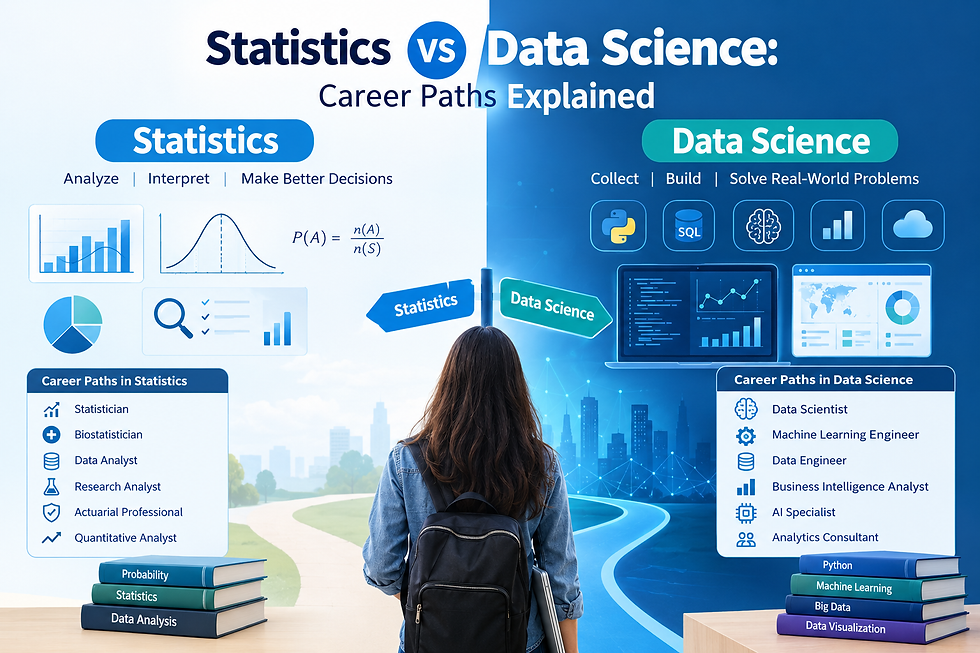
Choosing between Statistics vs Data Science can be challenging because both fields involve data, analytical thinking, mathematics, and problem-solving. However, they differ in their focus, tools, career opportunities, and applications. Statistics traditionally focuses on collecting, analyzing, interpreting, and presenting data, while Data Science combines statistics with programming, machine learning, databases, and modern technologies.
This guide explains the key differences between Statistics and Data Science and explores their career paths, skills, salaries, job roles, and future scope.
What Is Statistics?
Statistics is the study of collecting, organizing, analyzing, interpreting, and presenting data. Statisticians use mathematical techniques to identify patterns, measure uncertainty, test hypotheses, and support decision-making.
Statistics is widely used in healthcare, finance, government, education, research, economics, and business. Professionals may work with surveys, experiments, probability models, and statistical software to understand data and draw reliable conclusions.
A strong foundation in mathematics, probability, statistical methods, and analytical reasoning is important for building a career in statistics.
What Is Data Science?
Data Science is a multidisciplinary field that uses statistics, mathematics, programming, machine learning, databases, and domain knowledge to extract useful insights from data.
Data scientists work with structured and unstructured data to solve business and technical problems. They may collect data, clean datasets, build predictive models, create visualizations, and develop machine learning solutions.
Programming languages such as Python and R, along with SQL, machine learning frameworks, cloud platforms, and data visualization tools, are commonly used in Data Science careers.
Statistics vs Data Science: Key Differences
The major difference between Statistics vs Data Science is their overall scope. Statistics has a stronger focus on mathematical analysis, probability, inference, and understanding uncertainty. Data Science has a broader technology-oriented approach that combines statistical analysis with programming, machine learning, data engineering, and visualization.
Area | Statistics | Data Science |
Primary focus | Statistical analysis | Data-driven problem solving |
Mathematics | Very important | Important |
Programming | Useful | Essential |
Machine Learning | Selective use | Major component |
Data Engineering | Limited | Important |
Statistical inference | Core | Frequently used |
Typical tools | R, SAS, SPSS | Python, SQL, R, TensorFlow |
Career scope | Specialized | Broad and multidisciplinary |
Both fields can lead to rewarding careers, but the right choice depends on your interests and career goals.
Educational Requirements
Statistics careers commonly require a bachelor's or master's degree in statistics, mathematics, economics, or a related discipline. Advanced research and specialized positions may require postgraduate qualifications.
Data Science professionals can come from computer science, statistics, mathematics, engineering, economics, or other quantitative backgrounds. Many professionals also enter the field through specialized Data Science programs and certifications.
Students interested in Data Science should develop skills beyond statistics, particularly programming, databases, machine learning, and data visualization.
Skills Required for Statistics Careers
A statistics career requires strong quantitative and analytical abilities. Important skills include probability, statistical inference, regression analysis, hypothesis testing, experimental design, sampling techniques, and data interpretation.
Professionals should also be comfortable using statistical software such as R, SAS, SPSS, or Python. Communication is equally important because statisticians often need to explain analytical findings to non-technical stakeholders.
For advanced roles, knowledge of specialized statistical methods and research techniques can provide additional career opportunities.
Skills Required for Data Science Careers
Data Science requires a broader technical skill set. Professionals should understand statistics and probability while also developing programming and machine learning capabilities.
Important skills include Python, SQL, data cleaning, exploratory data analysis, data visualization, machine learning, predictive modeling, and database management. Knowledge of cloud computing and big data technologies can also be valuable.
Data scientists must combine technical knowledge with business understanding. They need to identify useful problems, analyze relevant data, and communicate insights that can support practical decisions.
Career Paths in Statistics
Statistics offers several specialized career paths. Graduates can work as statisticians, biostatisticians, statistical analysts, research analysts, actuarial professionals, quantitative analysts, or statistical consultants.
Biostatisticians, for example, analyze data related to healthcare, clinical research, and medical studies. Statistical analysts may work with business, financial, or operational datasets.
With experience and advanced education, professionals can move into research, consulting, management, or academic positions. Statistics can therefore provide a strong foundation for careers requiring rigorous quantitative analysis.
Career Paths in Data Science
Data Science provides a wide range of career opportunities because organizations increasingly depend on data-driven decision-making.
Potential roles include Data Scientist, Data Analyst, Machine Learning Engineer, Data Engineer, Business Intelligence Analyst, AI Specialist, and Analytics Consultant.
Experienced professionals may progress into senior data science, machine learning, analytics management, or AI leadership positions. Those who develop strong programming, machine learning, cloud, and business skills can explore opportunities across technology, finance, healthcare, retail, manufacturing, and other industries.
Job Roles and Responsibilities
Statisticians generally focus on designing studies, analyzing datasets, developing statistical models, testing hypotheses, and interpreting results. Their work often emphasizes accuracy, reliability, and statistical validity.
Data scientists may perform many of the same analytical activities but usually have broader responsibilities. They can collect and prepare data, build machine learning models, automate analytical processes, create dashboards, and develop predictive solutions.
The responsibilities can overlap, particularly in analytics-focused organizations, but Data Science generally includes a larger technology and programming component.
Industries Hiring Professionals
Both fields are used across numerous industries. Statistics professionals are particularly valuable in healthcare, pharmaceuticals, government, research, finance, insurance, education, and market research.
Data Science professionals are increasingly employed in technology, banking, e-commerce, healthcare, telecommunications, manufacturing, logistics, marketing, and financial services.
As organizations generate increasing volumes of data, professionals who can convert data into useful insights are becoming important across almost every major industry.
Statistics vs Data Science: Salary Potential
Salary varies considerably depending on location, education, experience, specialization, organization, and job title. Data Science roles can offer strong earning potential because they often require a combination of programming, statistics, machine learning, and business skills.
Statistics professionals can also achieve competitive salaries, especially in specialized areas such as biostatistics, actuarial analysis, quantitative finance, and advanced research.
Rather than choosing a field based only on salary, students should consider long-term career interests, skill requirements, job availability, and opportunities for professional growth.
Career Growth and Future Scope
The future scope of both fields remains strong because businesses, governments, and research organizations increasingly depend on data.
Statistics will continue to be important for research, experimentation, forecasting, risk analysis, and evidence-based decision-making. Data Science is expanding alongside artificial intelligence, machine learning, automation, and big data.
Professionals who combine statistical knowledge with modern technical skills can benefit from both fields. In fact, learning statistics can provide an excellent foundation for progressing into Data Science and machine learning.
Which Career Is Right for You?
Your choice between Statistics vs Data Science should depend on your interests and strengths.
Choose Statistics if you enjoy mathematics, probability, research, experiments, statistical modeling, and analytical reasoning. It may be particularly suitable if you want to work in research, healthcare, finance, or academic environments.
Choose Data Science if you enjoy programming, technology, machine learning, data visualization, and solving complex business problems. It can provide broader opportunities across technology and data-driven industries.
You can also combine both paths. A strong statistical foundation can make it easier to understand machine learning algorithms and build reliable data-driven solutions.
Conclusion:
The comparison of Statistics vs Data Science is not simply about choosing between two competing fields. Statistics provides a strong foundation for understanding data, probability, uncertainty, and analytical methods, while Data Science expands these concepts through programming, machine learning, data engineering, and modern technology.
If you prefer mathematical analysis and research, Statistics may be the better career path. If you want a broader technology-focused career involving programming and machine learning, Data Science may be a better fit.
Ultimately, both fields offer valuable and evolving career opportunities in a data-driven world.
FAQs
Is Statistics better than Data Science?
Neither field is universally better. Statistics is ideal for people interested in mathematical analysis and research, while Data Science is suitable for those interested in programming, machine learning, and technology.
Can a statistician become a data scientist?
Yes. Statisticians already possess valuable skills in probability, statistical modeling, data analysis, and inference. Learning Python, SQL, machine learning, and data engineering can help them transition into Data Science.
Is Data Science harder than Statistics?
The difficulty depends on your background and interests. Data Science generally requires a broader combination of statistics, programming, machine learning, and technology skills.
Which has more career opportunities?
Data Science generally covers a broader range of technology and analytics roles. However, Statistics offers strong opportunities in specialized areas such as healthcare, research, finance, insurance, and government.
Should I learn Statistics before Data Science?
Yes. A solid understanding of statistics can make it easier to understand data analysis, machine learning, experimentation, and predictive modeling.


Comments