.png)


Generative AI vs Machine Learning: Breaking Down the Hype and Reality

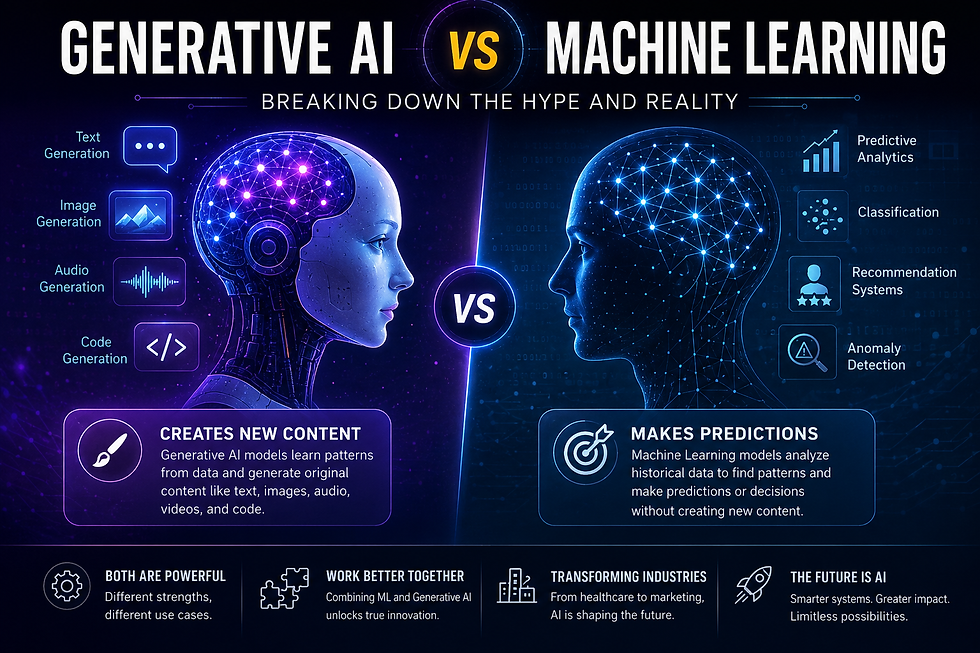
Artificial intelligence is evolving rapidly, and two terms dominate today’s tech discussions: Generative AI and Machine Learning. While both belong to the broader AI ecosystem, many people confuse them or use them interchangeably. Understanding Generative AI vs Machine Learning is essential for businesses, students, and professionals who want to stay ahead in the digital era.
Machine Learning has existed for decades and focuses on enabling machines to learn from data and improve performance over time. Generative AI, on the other hand, is a newer advancement that creates original content such as text, images, videos, music, and code.
The debate around Generative AI vs Machine Learning is growing because generative systems like chatbots and image generators are transforming industries. However, despite the hype, Machine Learning still remains the foundation of many intelligent systems.
This article breaks down the differences, applications, and realities behind these technologies to help you understand what truly sets them apart.
What Is Artificial Intelligence (AI)?
Artificial Intelligence, commonly known as AI, refers to computer systems designed to perform tasks that normally require human intelligence. These tasks include reasoning, decision-making, language understanding, problem-solving, and pattern recognition.
AI is the umbrella category under which both Machine Learning and Generative AI exist. Think of AI as the broad field, while Machine Learning and Generative AI are specialized branches.
AI systems can be categorized into several types:
Narrow AI – Designed for specific tasks such as voice assistants or recommendation engines
General AI – Theoretical AI with human-like reasoning capabilities
Super AI – Hypothetical intelligence exceeding human abilities
Examples of AI in daily life include:
Search engine algorithms
Smart assistants
Fraud detection systems
Navigation apps
Personalized recommendations
When comparing Generative AI vs Machine Learning, it is important to understand that both are subsets of AI, but they serve different purposes.
AI continues to evolve because of better algorithms, larger datasets, and improved computing power. This progress has led to the rise of Machine Learning and, more recently, Generative AI.
Understanding Machine Learning and How It Works
Machine Learning is a subset of AI that allows computers to learn patterns from data without being explicitly programmed for every task.
Instead of following fixed rules, Machine Learning systems analyze historical data, identify relationships, and make predictions or decisions based on learned patterns.
For example, if you want a system to detect spam emails, you can train a Machine Learning model using thousands of emails labeled as spam or non-spam. Over time, the model learns characteristics of spam messages and becomes better at identifying them.
Machine Learning typically follows these steps:
Data Collection
Large volumes of data are gathered from different sources.
Data Cleaning
The data is processed to remove errors and inconsistencies.
Model Training
Algorithms learn patterns from the training dataset.
Testing and Validation
Performance is evaluated using unseen data.
Deployment
The trained model is used in real-world applications.
Common types of Machine Learning include:
Supervised Learning
Uses labeled datasets to predict outputs.
Example:
House price prediction
Spam detection
Unsupervised Learning
Finds hidden patterns in unlabeled data.
Example:
Customer segmentation
Market basket analysis
Reinforcement Learning
Learns by trial and error using rewards and penalties.
Example:
Robotics
Self-driving cars
In the Generative AI vs Machine Learning discussion, Machine Learning primarily focuses on prediction, classification, and decision-making rather than content creation.
What Is Generative AI? A Beginner’s Explanation
Generative AI is a branch of artificial intelligence designed to create new content rather than simply analyzing existing data.
Unlike traditional Machine Learning models that predict outcomes, Generative AI produces entirely new outputs based on learned patterns.
Generative AI can create:
Articles
Images
Music
Videos
Voice
Software code
Examples include AI chatbots, image generators, and code assistants.
For instance, if you ask a Generative AI tool to create a marketing email, it can generate original text in seconds. Similarly, image-generation systems can create artwork from simple text prompts.
This capability makes Generative AI vs Machine Learning an exciting topic because Generative AI goes beyond prediction and enters the domain of creativity.
Generative AI models are trained on massive datasets containing text, visuals, and patterns. They learn structures and relationships, enabling them to generate realistic outputs.
Popular Generative AI technologies include:
Large Language Models (LLMs)
Generative Adversarial Networks (GANs)
Diffusion Models
Transformer Architectures
The rapid adoption of Generative AI is changing how businesses operate, especially in content creation and automation.
The Evolution of AI: From Machine Learning to Generative AI
AI did not become powerful overnight. It evolved through multiple technological breakthroughs.
Early Rule-Based AI
In the early stages, AI systems followed predefined rules. These systems lacked adaptability and struggled with complex tasks.
Rise of Machine Learning
Machine Learning changed everything by allowing systems to learn from data rather than relying only on hardcoded instructions.
This led to major advancements in:
Recommendation engines
Computer vision
Speech recognition
Predictive analytics
Deep Learning Revolution
Deep Learning introduced neural networks with multiple layers, enabling AI to process highly complex data.
This breakthrough improved:
Image recognition
Natural language processing
Voice generation
Emergence of Generative AI
The next leap came with Generative AI. Models trained on enormous datasets became capable of generating human-like outputs.
The evolution from Machine Learning to Generative AI shows how AI moved from:
Rule followingto
Pattern learningto
Content creation
This progression is central to understanding Generative AI vs Machine Learning.
Core Differences Between Generative AI and Machine Learning
Understanding the core differences helps clarify the debate around Generative AI vs Machine Learning.
Purpose
Machine Learning focuses on:
Prediction
Classification
Pattern recognition
Generative AI focuses on:
Content generation
Creativity
Simulation
Output
Machine Learning outputs:
Predictions
Labels
Recommendations
Generative AI outputs:
Text
Images
Audio
Videos
Data Usage
Machine Learning learns patterns for decision-making.
Generative AI learns patterns to create entirely new data.
Complexity
Generative AI models often require more computational power than traditional Machine Learning systems.
Use Cases
Machine Learning:
Fraud detection
Sales forecasting
Customer segmentation
Generative AI:
Content writing
AI art generation
Virtual assistants
When discussing Generative AI vs Machine Learning, neither is better universally. Their usefulness depends on the problem being solved.
How Machine Learning Models Learn from Data
Machine Learning models learn by identifying mathematical relationships within datasets.
The learning process begins when data is fed into algorithms. The algorithm adjusts internal parameters to reduce prediction errors.
For example, if a model predicts stock prices incorrectly, it updates its parameters to improve future predictions.
Key components of learning include:
Features
Input variables used by the model.
Examples:
Age
Income
Purchase history
Labels
Correct outputs for supervised learning.
Example:Spam or Not Spam
Loss Function
Measures prediction error.
Optimization
Algorithms adjust weights to reduce errors.
Popular Machine Learning algorithms include:
Linear Regression
Decision Trees
Random Forest
Support Vector Machines
Neural Networks
This learning mechanism defines a major difference in Generative AI vs Machine Learning because Machine Learning learns to predict, not create.
How Generative AI Creates New Content
Generative AI creates content by learning the structure and probability distributions of massive datasets.
Instead of memorizing exact outputs, it learns patterns, relationships, and context.
For example, a text model learns:
Grammar
Sentence structure
Word relationships
Context patterns
When prompted, it predicts the most suitable next sequence to generate coherent output.
Generative AI creation process involves:
Training Phase
Models analyze billions of data points.
Pattern Learning
The system understands relationships between inputs.
Content Generation
New outputs are generated based on prompts.
For image generation, AI learns:
Shapes
Colors
Styles
Textures
This ability to generate realistic outputs is why Generative AI vs Machine Learning is such a major topic in technology today.
Generative AI does not simply copy existing data—it synthesizes new combinations based on learned patterns.
Popular Technologies Behind Machine Learning
Several powerful technologies drive Machine Learning systems.
Programming Languages
Popular choices include:
Python
R
Julia
Frameworks
Developers commonly use:
TensorFlow
PyTorch
Scikit-learn
Cloud Platforms
Machine Learning deployment often uses cloud infrastructure such as:
Data Engineering Tools
These handle large datasets efficiently.
Examples:
Apache Spark
Hadoop
Machine Learning success depends heavily on data quality, computational power, and model selection.
These technologies form the backbone of modern predictive AI systems.
Key Models Used in Generative AI (LLMs, GANs, Diffusion Models)
Generative AI relies on advanced models capable of producing human-like outputs.
Large Language Models (LLMs)
LLMs generate natural language text by understanding context and semantics.
Examples include conversational AI and writing assistants.
Generative Adversarial Networks (GANs)
GANs consist of two neural networks:
Generator
Discriminator
The generator creates content while the discriminator evaluates realism.
GANs are widely used for:
Image synthesis
Face generation
Style transfer
Diffusion Models
Diffusion models generate high-quality images by gradually transforming random noise into meaningful visuals.
They are popular in modern AI art systems.
These advanced models highlight the biggest shift in Generative AI vs Machine Learning—moving from prediction-based intelligence to creation-based intelligence.
As Generative AI continues evolving, these models will become even more powerful and accessible.
Real-World Applications of Machine Learning
Machine Learning powers many systems people use daily, often without realizing it. Its ability to analyze data, recognize patterns, and make predictions makes it valuable across industries.
Healthcare
Machine Learning helps doctors detect diseases early through predictive analytics and medical imaging. It assists in identifying conditions such as cancer, diabetes, and heart disease.
Finance
Banks use Machine Learning for:
Fraud detection
Credit scoring
Risk assessment
Algorithmic trading
E-commerce
Online stores use Machine Learning for personalized recommendations and customer behavior analysis.
Examples include:
Product suggestions
Dynamic pricing
Inventory forecasting
Manufacturing
Factories use Machine Learning for predictive maintenance, reducing downtime and improving efficiency.
In the Generative AI vs Machine Learning discussion, Machine Learning dominates tasks requiring forecasting and intelligent decision-making.
Real-World Applications of Generative AI
Generative AI is transforming industries by creating original content at scale.
Content Creation
Writers and marketers use Generative AI for:
Blog writing
Ad copy
Social media posts
Product descriptions
Design and Art
AI tools generate:
Logos
Digital paintings
Marketing visuals
UI prototypes
Entertainment
Generative AI creates:
Music
Video effects
Game environments
Animation
Software Development
Developers use AI coding assistants to generate code snippets, debug programs, and automate repetitive tasks.
This rapid expansion explains why Generative AI vs Machine Learning is such a hot topic—Generative AI is entering creative industries once considered human-only.
Benefits of Machine Learning for Businesses
Businesses rely on Machine Learning to improve efficiency, reduce costs, and enhance decision-making.
Better Decision-Making
Machine Learning analyzes large datasets to uncover actionable insights.
This helps businesses:
Predict customer demand
Improve strategy
Reduce uncertainty
Automation
Repetitive analytical tasks can be automated, saving time and resources.
Examples:
Fraud monitoring
Customer segmentation
Forecasting
Personalization
Companies can deliver personalized experiences based on user behavior.
Examples include:
Product recommendations
Targeted ads
Customized offers
Cost Reduction
Predictive maintenance and optimized operations help reduce expenses.
In Generative AI vs Machine Learning, Machine Learning remains essential for operational intelligence and data-driven business growth.
Advantages of Generative AI in Modern Industries
Generative AI offers unique benefits that traditional AI systems cannot easily provide.
Faster Content Production
Generative AI drastically reduces content creation time.
Tasks that took hours can now be completed in minutes.
Increased Creativity
AI helps generate fresh ideas, design concepts, and creative drafts.
This supports professionals in:
Marketing
Design
Media
Education
Scalability
Businesses can produce content at massive scale without proportional increases in cost.
Examples:
Personalized emails
AI chat responses
Marketing campaigns
Enhanced Productivity
Employees can focus on strategic tasks while AI handles repetitive creative work.
The rise of these benefits is a major reason the Generative AI vs Machine Learning debate continues to intensify.
Limitations and Challenges of Machine Learning
Despite its power, Machine Learning has several limitations.
Data Dependency
Machine Learning models need large, high-quality datasets.
Poor data leads to poor predictions.
Bias in Data
If training data contains bias, the model can produce unfair outcomes.
This can impact:
Hiring systems
Loan approvals
Healthcare recommendations
Limited Adaptability
Traditional Machine Learning models often struggle with unfamiliar situations outside their training data.
High Maintenance
Models require continuous retraining as data changes.
These challenges matter in the Generative AI vs Machine Learning comparison because both technologies depend heavily on data quality.
Risks and Ethical Concerns in Generative AI
Generative AI introduces powerful capabilities, but also serious risks.
Misinformation
AI can generate highly convincing fake content.
Examples:
Fake news
Deepfake videos
False images
Copyright Issues
Generative models may unintentionally reproduce copyrighted material from training datasets.
This creates legal and ethical concerns.
Hallucinations
Generative AI sometimes produces incorrect information with high confidence.
This is especially risky in:
Healthcare
Finance
Education
Job Disruption
Automation of creative tasks raises concerns about workforce displacement.
In the Generative AI vs Machine Learning conversation, ethical concerns are much greater for Generative AI due to its content-generation power.
Generative AI vs Machine Learning: Which Is More Powerful?
There is no simple answer to which is more powerful in Generative AI vs Machine Learning.
The better technology depends entirely on the use case.
Choose Machine Learning when you need:
Predictions
Classification
Forecasting
Risk analysis
Choose Generative AI when you need:
Content creation
Conversational systems
AI design tools
Creative automation
Machine Learning excels in analytical intelligence.
Generative AI excels in creative intelligence.
Rather than competing, both technologies often work together. In many modern systems, Machine Learning powers analysis while Generative AI handles user-facing output.
The future likely belongs to hybrid AI systems combining both strengths.
Career Opportunities in AI and Machine Learning
The AI industry is creating enormous career opportunities worldwide.
Popular roles include:
Machine Learning Engineer
Builds predictive models and AI systems.
Skills needed:
Python
Statistics
Data modeling
Data Scientist
Extracts insights from large datasets.
Responsibilities include:
Data analysis
Visualization
Business intelligence
AI Research Engineer
Develops advanced algorithms and neural architectures.
Prompt Engineer
A newer role focused on optimizing AI prompts for Generative AI systems.
The growing demand around Generative AI vs Machine Learning is driving salaries and job opportunities higher across industries.
Future Trends: Will Generative AI Replace Traditional ML?
Many people wonder whether Generative AI will replace Machine Learning entirely.
The short answer is no.
Generative AI is powerful, but Machine Learning remains critical for prediction-heavy tasks.
Future AI trends include:
Hybrid Models
Systems combining predictive analytics with content generation.
Multimodal AI
Models processing text, image, audio, and video together.
Smaller Efficient Models
AI models becoming cheaper and faster to deploy.
Domain-Specific AI
Customized AI solutions for healthcare, law, finance, and education.
The future of Generative AI vs Machine Learning is not replacement—it is integration.
Both will continue evolving together.
Conclusion:
The discussion around Generative AI vs Machine Learning often becomes exaggerated because of media hype. While Generative AI has captured public attention with impressive content creation, Machine Learning continues to power the majority of intelligent systems behind the scenes.
The reality is simple:
Machine Learning helps machines analyze and predict
Generative AI helps machines create
Both technologies are reshaping industries, careers, and business strategies.
Understanding the true differences between Generative AI vs Machine Learning allows individuals and organizations to make smarter technology decisions.
As AI evolves, success will come not from choosing one over the other, but from understanding how both can work together to create real value.


Comments