.png)


Understanding Cognitive Systems: Meaning, Features, and Applications

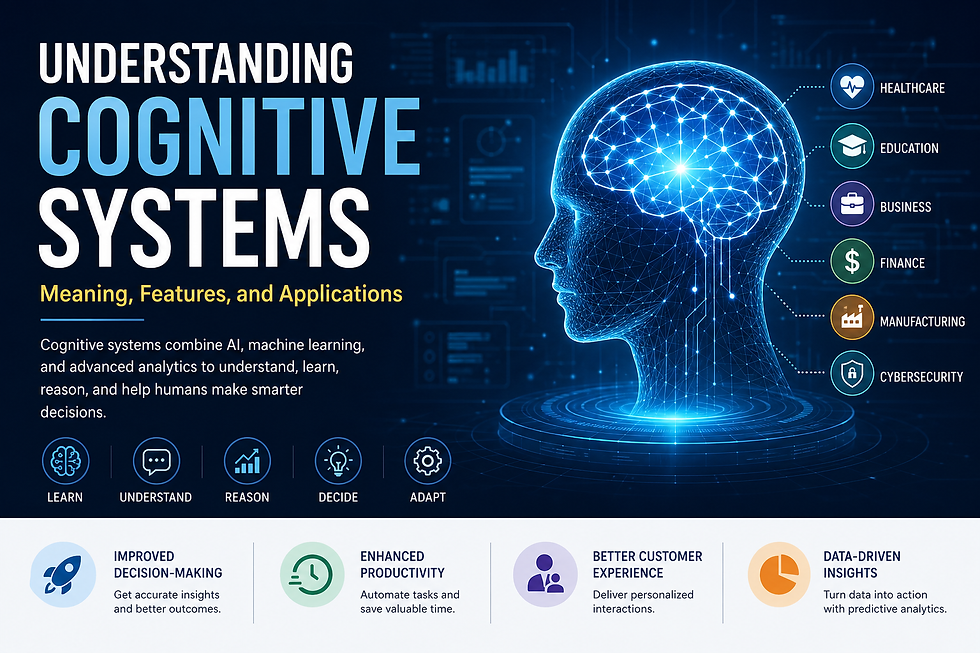
Technology is evolving rapidly, and machines are becoming smarter than ever before. One of the most exciting innovations in artificial intelligence is cognitive systems. These systems are designed to simulate human thought processes such as learning, reasoning, understanding language, and problem-solving. Unlike traditional software, cognitive systems can process massive amounts of structured and unstructured data to generate intelligent insights. Businesses, healthcare providers, and educational institutions increasingly rely on cognitive systems to improve efficiency, accuracy, and decision-making.
What Are Cognitive Systems? Meaning Explained
If you are wondering what are cognitive systems, they are advanced computing systems that mimic human cognitive abilities. These abilities include perception, memory, reasoning, learning, and decision-making. Cognitive systems analyze data, recognize patterns, and continuously improve through experience.
In simple terms, cognitive systems do more than follow fixed rules. They understand context, interpret information, and provide recommendations based on available data. This makes them highly valuable in situations requiring intelligent responses and adaptive behavior.
Why Cognitive Systems Matter in Modern Technology
Modern industries generate enormous volumes of data every day. Traditional computing systems struggle to interpret this complex information effectively. Cognitive systems solve this challenge by transforming raw data into meaningful insights.
They help organizations make faster decisions, automate repetitive tasks, and improve user experiences. From personalized recommendations in e-commerce to AI-powered healthcare diagnosis, cognitive systems have become essential. Their ability to understand human behavior and respond intelligently makes them a critical component of modern digital transformation.
The Core Concept Behind Cognitive Computing
The foundation of cognitive systems lies in cognitive computing, a field that combines artificial intelligence, machine learning, natural language processing, and data analytics. The main goal is to create systems that interact with humans naturally and intelligently.
Unlike standard software that executes predefined instructions, cognitive computing enables systems to learn from interactions. These systems observe patterns, process new information, and refine outputs over time. This human-like adaptability is what makes cognitive systems powerful and practical.
How Cognitive Systems Work Step by Step
Understanding what are cognitive systems becomes easier when we look at how they work. Cognitive systems typically follow a structured process:
First, they collect data from multiple sources such as text, speech, images, and databases.Second, they analyze this data using AI algorithms.Third, they identify patterns and relationships within the information.Finally, they generate insights, predictions, or recommendations.
Over time, these systems learn from feedback and improve accuracy. This continuous learning process allows cognitive systems to become smarter with every interaction.
Key Components of Cognitive Systems
Several technologies work together to build effective cognitive systems. These core components include:
Data Processing: Handles structured and unstructured data from multiple sources.
Machine Learning: Enables systems to learn from historical data and improve predictions.
Natural Language Processing (NLP): Helps systems understand human language in text or speech.
Knowledge Representation: Organizes information for reasoning and decision-making.
Reasoning Engines: Support logical analysis and recommendation generation.
These components allow cognitive systems to perform intelligent tasks efficiently.
Major Features of Cognitive Systems
Cognitive systems have unique capabilities that differentiate them from traditional software. Key features include:
Learning Ability: Systems improve performance through experience.
Adaptive Behavior: They adjust based on changing data or environments.
Human Interaction: They communicate using natural language.
Pattern Recognition: They identify trends and hidden relationships in data.
Context Awareness: They understand situations and respond accordingly.
These features make cognitive systems highly useful across industries that require smart automation and accurate decision-making.
Learning and Adaptation in Cognitive Systems
A major strength of cognitive systems is their ability to learn and adapt. Traditional software follows static programming, but cognitive systems evolve with new data.
For example, a customer support chatbot powered by cognitive systems can improve after thousands of user interactions. It learns common questions, understands user intent, and delivers better responses over time.
This adaptability ensures long-term efficiency and makes cognitive systems suitable for dynamic environments where constant change occurs.
Role of Artificial Intelligence in Cognitive Systems
Artificial intelligence is the driving force behind cognitive systems. AI enables machines to simulate intelligence and perform tasks requiring human-like reasoning.
Machine learning helps systems recognize patterns. Deep learning improves complex data analysis such as image recognition. Natural language processing allows systems to understand conversations.
Without AI, cognitive systems would not be able to analyze large datasets or provide intelligent recommendations. AI gives these systems the ability to think, learn, and respond effectively.
Cognitive Systems vs Traditional Computing
The difference between cognitive systems and traditional computing lies in intelligence and adaptability.
Traditional systems rely on predefined rules and fixed programming. They execute tasks exactly as instructed and struggle with ambiguity.
Cognitive systems, however, can learn from data, interpret context, and improve over time. They are designed for uncertainty and complex decision-making.
In simple terms, traditional computing focuses on automation, while cognitive systems focus on intelligence. This makes cognitive systems better suited for modern AI-driven applications.
Benefits of Using Cognitive Systems
Cognitive systems offer numerous advantages across industries. One major benefit is improved decision-making through real-time data analysis. These systems can process vast datasets faster than humans and identify meaningful insights.
They also increase operational efficiency by automating repetitive tasks. Cognitive systems reduce human error, improve productivity, and enhance customer experiences through personalization. Their learning capability makes them increasingly valuable over time, helping organizations stay competitive in fast-changing markets.
Applications of Cognitive Systems in Healthcare
Healthcare is one of the most impactful areas for cognitive systems. These systems help doctors analyze medical records, research papers, and patient data to support diagnosis and treatment planning.
For example, cognitive systems can identify disease patterns from scans and lab reports, enabling faster diagnosis. They also assist in personalized treatment recommendations and drug discovery. By improving accuracy and reducing delays, cognitive systems help healthcare providers deliver better patient outcomes and more efficient care.
Use of Cognitive Systems in Education
Education is becoming smarter with the adoption of cognitive systems. These systems help create personalized learning experiences based on student behavior, strengths, and weaknesses.
AI-powered tutoring platforms can adapt lessons according to individual progress. Cognitive systems also assist teachers by analyzing student performance and identifying learning gaps. Virtual assistants and intelligent learning tools make education more interactive and accessible. As a result, students receive better support and institutions improve learning effectiveness.
Cognitive Systems in Business and Customer Service
Businesses use cognitive systems to improve customer engagement and operational efficiency. AI chatbots and virtual assistants provide instant responses to customer queries, improving service quality.
Cognitive systems also analyze customer behavior, preferences, and purchase history to offer personalized recommendations. In business operations, they support demand forecasting, risk analysis, and strategic planning. This enables organizations to enhance decision-making while delivering better customer experiences and stronger brand loyalty.
Applications in Finance and Banking
The finance and banking sector relies heavily on cognitive systems for data-driven decisions. These systems help detect fraud by identifying suspicious transaction patterns in real time.
They also improve risk assessment, automate customer support, and assist in investment analysis. Banks use cognitive systems to personalize financial advice and streamline operations. With increasing digital transactions, these intelligent systems help financial institutions improve security, efficiency, and customer trust.
Role of Cognitive Systems in Cybersecurity
Cybersecurity has become more complex due to growing digital threats. Cognitive systems play a vital role in detecting and preventing cyberattacks.
These systems analyze network behavior, identify anomalies, and recognize potential threats before they cause damage. Unlike traditional security tools, cognitive systems can learn from new attack patterns and adapt quickly. They improve threat intelligence, incident response, and security monitoring, making them essential for modern cybersecurity strategies.
Challenges and Limitations of Cognitive Systems
Despite their advantages, cognitive systems face several challenges. One major issue is data quality. Poor or biased data can lead to inaccurate outputs and flawed decisions.
Implementation costs can also be high, especially for small businesses. Privacy and security concerns arise when handling sensitive information. Additionally, cognitive systems may struggle with highly emotional or nuanced human interactions. Addressing these limitations is essential for responsible and effective adoption.
Future Trends in Cognitive Systems
The future of cognitive systems looks highly promising. As AI technologies continue to advance, these systems will become more accurate, efficient, and human-like.
Future developments may include better emotional intelligence, advanced reasoning, and stronger real-time decision-making capabilities. Integration with emerging technologies such as robotics, IoT, and edge computing will further expand their applications. Cognitive systems are expected to become a core part of next-generation digital transformation across industries.
How Businesses Can Adopt Cognitive Systems
Businesses planning to adopt cognitive systems should begin by identifying areas where intelligent automation can create value. Common use cases include customer service, analytics, cybersecurity, and process optimization.
Organizations must invest in quality data, AI infrastructure, and skilled professionals. Starting with small pilot projects helps evaluate performance before scaling. A clear implementation strategy ensures smoother adoption and better long-term returns from cognitive technologies.
Conclusion:
Understanding what are cognitive systems is essential in today’s AI-driven world. These intelligent systems are transforming industries by enabling machines to learn, reason, and make better decisions.
From healthcare and education to finance and cybersecurity, cognitive systems are creating powerful opportunities for innovation. As technology evolves, their influence will continue to grow. Businesses and professionals who embrace cognitive systems today will be better prepared for the intelligent future ahead.


Comments